News
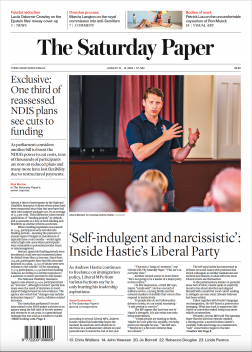
According to senior sources, the Liberal Party’s failure to reflect the demographics of the country has made its chance of re-election ‘finished’ without reform. By Mike Seccombe.
Liberal Party ‘finished’ without reform
The federal Liberal Party will remain unelectable unless it can find ways to attract not only more women candidates but also more support from young, diverse, educated and urban voters. On that, there is broad agreement among the realists in the party’s upper echelons.
“This is a bigger problem than just getting more women into the party. It is a problem of getting more talented people in the party, including women,” a senior Liberal tells The Saturday Paper.
“We have a problem with people from a multicultural background, including particularly people from Chinese and Indian backgrounds. We have an issue with people who are young as well and those who don’t own their own home. We also have alienated people who are highly educated.
“And when you put all those together, there are whole, large components of Australian society that feel not only that we don’t fight for them but that we’re hostile to them.”
Unless this changes, the source says, “we’re finished”.
Despite some agreement on the problems the party faces, it remains riven over what to change and how to get that change through the party’s decentralised, state-based structure. Then there is the matter of getting it past its increasingly elderly, conservative, male and shrunken membership.
In the wake of the Liberals’ worst election defeat, there has been a renewed push since May for the party to set gender quotas for candidates – and also spirited pushback from those who claim candidate selection should be based on merit rather than gender, as if the two concepts are mutually exclusive.
A second option for change, long advocated by shadow attorney-general Julian Leeser, which has gained some traction over the past couple of weeks, is to open up the candidate selection process through the adoption of United States-style primary ballots that would give a vote to party supporters, rather than just members.
Both ideas face formidable structural, cultural and factional hurdles. The prospects of either proposal being adopted, in the view of many in the party, are not good.
Yet, as the senior source tells The Saturday Paper, unless the Liberal Party finds a way to broaden its appeal, it will continue to suffer “a spiral of disaster that feeds on itself”, rendered incapable of ever returning to government.
Following the election result, the party initiated multiple inquiries into what went wrong. For the source, it’s obvious.
“We ran a campaign that was focused on Anglo tradies in the outer suburbs, whereas the truth is most Australians are multicultural, female, highly educated, who live in the cities. Unless we appeal to them, we don’t have a future.
“Look at the electoral maps of metropolitan Melbourne and Sydney. They are seas of red, green and teal.”
It’s a lament echoed by other senior sources: the Liberal Party does not reflect the demographic make-up of contemporary Australia.
“Male, pale and stale,” says another senior party source from New South Wales, noting that the average age among branch members in that state is now over 70.
It is about the same in Victoria and, the source says, about the same in other states.
Women, who were once more inclined than men to be conservative voters, began drifting away decades ago. Since about the turn of the century they have been increasingly likely to vote for progressive parties. The gender gap in 2022 was 4-5 per cent.
Even more pronounced, though, is the Liberals’ loss of support among younger voters. The long-running, definitive record of Australian voting patterns, the Australian Election Study, shows a pronounced leftward shift among younger cohorts since the mid 2010s.
In 2022, voters aged 18-24 were more likely to vote for the Greens than the Liberal Party.
Worse for the conservatives is the fact the formerly accepted wisdom that voters grew more conservative as they aged seems no longer to apply. As a result, ever-older cohorts are voting for parties of the left.
In its report after the 2022 election, the Australian Election Study said: “Only about one in four voters under the age of 40 reported voting for the Coalition in 2022.
“At no time in the 35-year history of the AES have we observed such a low level of support … in so large a segment of the electorate. By contrast, support for Labor remained virtually unchanged from 2019 to 2022, with about 38 percent of voters under the age of 40 supporting Labor.”
The study’s report on the 2025 election is yet to be completed, but Ian McAllister, distinguished professor of politics and international relations at the Australian National University and a lead author of the study, expects the trend away from the conservatives to continue.
“The three things that matter in terms of voting behaviour these days are gender, university education and age,” he says. “And if you know those three things, you know pretty well how somebody’s going to vote.”
Based on the data, the chances of a university-educated woman in her 20s voting for the Liberal Party are below 20 per cent.
Another issue for the conservatives is the growing number of people eschewing both major parties for minor party candidates or independents – now about one third of voters.
When those votes go to preferences, they tend to favour Labor over the Coalition.
A recent analysis by The Australia Institute of voting patterns at the May election shows 62 per cent of preferences went to Labor and 38 per cent to the Coalition.
The problem is clear: the Liberal Party is at a demographic dead end. It still gets a majority of votes from Baby Boomers, but they are dying off and subsequent generations are increasingly unlikely to support the conservatives.
So to the proposed solutions, starting with gender quotas.
It’s hardly a new idea.
The Labor Party first adopted quotas more than 30 years ago and has now achieved gender parity across the parliament. The Albanese cabinet now has equal numbers of men and women.
Among the Greens and independents in federal parliament there are now more women than men. Yet the Liberal Party is going backwards.
As Albanese has frequently commented since the election, there now are more women in the Labor Caucus “whose first name begins in A than there are Liberals and National women in the House of Representatives”.
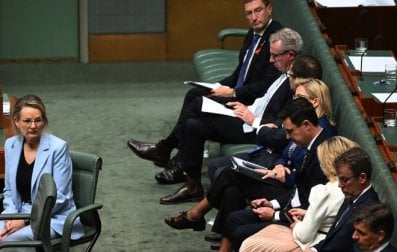
Last week, the ABC’s Annabel Crabb noted a report commissioned a decade ago by the Liberal Party’s federal secretariat advocated a target of 50 per cent female candidates by 2025. Yet the Liberal class of 2025 included just six women members of the house, out of 28.
As Crabb pithily put it, assuming the party’s new leader, Sussan Ley, took a COMCAR to Parliament House, the rest of the Liberal women MPs “can get there in a Corolla”.
It is clear that targets don’t work, but quotas do.
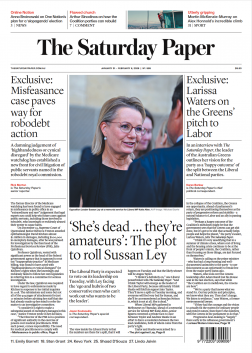
Those quotas are now an issue of factional tension, which helps explain why Ley, having declared herself a “zealot” in the cause of increasing female representation, will not commit to them.
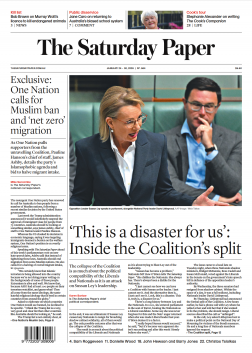
Angus Taylor, the man she beat for the party leadership, by just 29 votes to 25, pays lip-service to the need for a “crusade” to recruit more women but remains implacably opposed to quotas. They would, he says, “subvert democratic processes” within the party.
In the view of many, however, the real concern for Taylor and his allies in the party’s conservative wing and among right-wing commentators is that quotas would bring in more moderate members. The argument against quotas, critics say, is simply factionalism dressed as principle.
Says one senior moderate: “To argue for rank-and-file preselection every time sounds nice and democratic, but when the party is so unrepresentative of the broader community, it’s not really democracy. All you’re doing is entrenching one set of views.”
Even many of those who support the idea of quotas in principle see little chance of it happening. Part of the problem is the federated structure of the party.
“Each of the divisions are sovereign and each of them have their own constitution,” says one moderate MP.
“So even if there was broad agreement in the parliamentary party or in the leadership to have quotas, the chances of getting that up in a constitutional change in each of the divisions is next to zero.”
Given the narrow margin by which Ley won the leadership, and Taylor’s ambitions, the MP suggests, it is not a fight worth starting.
So what of Leeser’s suggested alternative of open primaries?
As he explained on radio this week, his preferred model would see “a system where the local party members would shortlist a range of candidates who would then be put out to the general community in the electorate to be able to vote on at a nominated date”.
Voting would not be restricted to party members. Leeser suggests a broader process. “People would vote at a local school or a local hall just as they do on election day.”
The idea is that the primary system would encourage participation by more members of the community, and people more diverse than the average 70-something party member.
Yet the idea runs up against the same objection as quotas: it would require constitutional change across the various divisions and would dilute the influence of rank-and-file party members.
As one source said: “I think it’s a good idea that will never be implemented because the logistics of it are so hard.”
Critics also worry that the primary system could be manipulated by people who did not have the best interests of the party in mind and who would support the candidate they considered the weakest. There also is the issue of cost, and the prospect of vested interests spending big money in support of one or other candidate, as happens in the US, where both parties conduct hugely expensive primaries.
One source also worried that such a system might deepen the factional rifts in the party and make them more publicly obvious.
Some media reporting this week suggested Taylor had endorsed the primary model, but his office later clarified he had simply acknowledged it as one option that might be considered.
Long story short, there are two good ideas for reform of a political party that is sliding towards political irrelevance, neither of which is likely to be adopted.
Which, says one source who claims optimism for the party’s future notwithstanding all the evidence of decline, leaves only one option: “Real leadership, to get people moving within the rules that we have right now.”
That puts enormous pressure on the party’s first female leader to work within the current constraints to identify and promote talent.
The alternative, the source says, is not just disaster for the Liberal Party but “that our whole democracy is compromised”.
“And that’s something that should terrify everyone, no matter who you vote for. If we don’t have a credible alternative that is made up of people who reflect contemporary Australia, it is not, I think, good news for our democracy.”
This article was first published in the print edition of The Saturday Paper on July 12, 2025 as "Dead end for the Liberal Party".
For almost a decade, The Saturday Paper has published Australia’s leading writers and thinkers. We have pursued stories that are ignored elsewhere, covering them with sensitivity and depth. We have done this on refugee policy, on government integrity, on robo-debt, on aged care, on climate change, on the pandemic.
All our journalism is fiercely independent. It relies on the support of readers. By subscribing to The Saturday Paper, you are ensuring that we can continue to produce essential, issue-defining coverage, to dig out stories that take time, to doggedly hold to account politicians and the political class.
There are very few titles that have the freedom and the space to produce journalism like this. In a country with a concentration of media ownership unlike anything else in the world, it is vitally important. Your subscription helps make it possible.
Subscriber exclusive
Send this article to a friend for free.
Share this subscriber exclusive article with a friend or family member using share credits.