News
As Labor prepares to introduce a partial ban on gambling advertising, it faces internal dissent and an opposition strategy to paint the party as untrustworthy. By Karen Barlow.
Labor’s punt on diluted gambling reforms ‘a betrayal’
Last November, an utterly determined Peta Murphy attended parliament as she faced the last days of her long battle with breast cancer.
The Labor backbencher was in the chamber to ask a question on housing, but instead heard testimony to her quiet courage and strength.
“The member for Dunkley is a warrior for causes she is passionate about. She’s a warrior for fairness, equality, women’s rights and breast cancer, and a champion for battlers in her own community,” Nationals frontbencher Darren Chester said from across the aisle.
“In the words of Pippi Longstocking: please remember you are the strongest girl in the world.”
Murphy, touted by Anthony Albanese as a future cabinet minister and whose legacy he praised, was also a champion for ending online gambling ads. She chaired an inquiry that issued a report with 31 unanimous recommendations, including a phased, comprehensive ban on all gambling advertising across all media within three years – a reform “that leaves no room for circumvention”.
In the report, tabled in June last year, Murphy said: “The torrent of advertising is inescapable. It is manipulating an impressionable and vulnerable audience to gamble online.”
The report suggested a three-year timeframe would allow major sports and broadcasters to find an alternative source of revenue. Murphy emphasised in the “You win some, you lose more” report that “partial bans on gambling advertising do not work”.
The government response, however, is expected to result in a partial ban. The suggestion is for no gambling ads during a sports broadcast, as well as in the hour before and after. There would also be a ban during children’s programs and a limit of two ads an hour on each channel until 10pm.
“All the evidence shows it will not work,” independent MP Andrew Wilkie tells The Saturday Paper. “The money will just slosh into the gaps between the banned periods, and there’ll be periods when kids are watching the telly.
“I’m alarmed that the government is hoping to buckle to the industry and to satisfy its fear of the industry and the gambling industry, the media industry and the sporting codes.
“I’ve very deliberately said ‘hoping to’, because I don’t think it’s a done deal.”
Pressure to adopt a full ban is being applied inside and outside the Labor Party. Calls for the cabinet to back a full ban have come from the deputy chair of the House committee that conducted the review, Nationals MP Pat Conaghan, committee members Keith Wolahan (Liberal) and Maria Vamvakinou (Labor), as well as from Labor MPs Mike Freelander, Jodie Belyea and Louise Miller-Frost.
Crossbenchers insist there are others in the major parties who also support a full ban.
“The thing that I think is really sad is there are people on both sides of the House who really want to see this reform happen, and they quietly walk past us and say, ‘Keep it up. Keep up the pressure.’ But they can’t say that out loud, even though that’s what their communities want,” the independent member for Curtin, Kate Chaney, tells The Saturday Paper.
Wilkie says backbenchers are also coming to him privately, although he adds some were coming to say the government was on the right track. A new anti-gambling alliance is also on the case, including former prime ministers John Howard and Malcolm Turnbull, and other figures such as Rosie Batty, Craig Foster and Father Frank Brennan.
“I know for a fact there is pressure within the Labor Party, there’s pressure within the Liberal Party, the LNP, and there’s enormous pressure in the community,” Wilkie says.
The committee heard about the extreme harm caused by gambling and applied a public health lens as it sought ways to reduce the impacts.
Independent Senator Jacqui Lambie berated the government, pointing to research from the Australian Institute of Family Studies.
“Nineteen per cent of young women and 25 per cent of young men started betting for the first time after seeing and hearing an ad on TV,” the Tasmanian representative said. “Research also shows that high exposure to gambling ads increases the chances these kids will develop gambling problems in the future.
“So, I would say to the government and to the free-to-air channels that this money is absolutely filthy, dirty, disgusting, disgraceful money, and you should be ashamed of yourself. You’re unconscionable.”
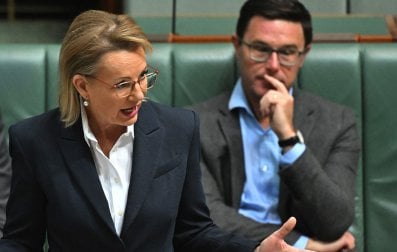
Communications Minister Michelle Rowland and Social Services Minister Amanda Rishworth are leading the government’s response on implementing the reforms. The telling line, however, came from Employment and Workplace Relations Minister Murray Watt, who said a “balanced approach” was sought in the face of overwhelming concern.
“What we need to do is balance that concern with the reality that gambling advertising is an important revenue source for free-to-air TV, which, as you know, is under threat from social media enterprises at the moment,” Watt said.
“It’s also an important revenue source for sporting codes.”
Government Services Minister Bill Shorten was also unable to assist those working for an outright ad ban, warning that free-to-air media was in “diabolical trouble” and he was not convinced complete prohibition worked.
Harking back to tough media treatment in his time as opposition leader, Shorten said he was standing for media diversity.
“I am not arguing in favour of Seven, Nine or Ten. As individual corporations, they’ve never done me any favours,” he told the ABC.
“I’ve run for, you know, I’ve run for prime minister. I’ve seen how heavy media institutions can pile in. But you know what? Free-to-air TV is at least a voice of diversity in a world where we’re getting a lot of misinformation.”
The Greens say gambling addicts and vulnerable children should not pay the price, however.
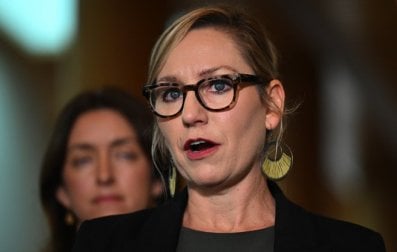
“Don’t buy Bill Shorten’s lie. Don’t buy it,” Greens Senator Sarah Hanson-Young told reporters. “We should be taxing these big tech companies. We should be taxing them. We should be funding journalism and we should be stopping the insidious gambling advertising being pushed down the throats of Australians. The government could do all those things if they had some guts.”
While government consultations are under way, the Greens want to test the waters and tack a full gambling ad ban onto a government regional communications bill currently in the Senate.
Major party solidarity means it is very unlikely to get up. Earlier, independent ACT Senator David Pocock unsuccessfully tried to pass an urgent Senate motion as a proxy ban on gambling ads.
It failed, but Liberal National Party Senator Gerard Rennick voted against the rest of his party to support the motion, as did former Labor senator Fatima Payman.
Pocock has accused Labor of giving in to the demands of big media, big sport and the gambling industry.
“It’s absolutely a betrayal of Peta Murphy and her legacy, and it’s a betrayal of Australians. Eighty per cent of Australians want this,” he told RN Breakfast.
“And we have a government that doesn’t have the guts to actually stand up to the gambling industry, doesn’t have the imagination to actually work with TV to find a way to ensure that they are viable.”
This has infuriated some Labor MPs. One senior government source told The Saturday Paper the independents should not “hide” behind Peta Murphy, who spent her entire life in the Labor movement.
“I think it’s disgusting and a dishonest way to argue,” the source said.
Another Labor MP pointed to Murphy’s way of quiet diplomacy and suggested she would have wanted that to continue.
Still, there is strong community distaste for gambling ads, according to the Australian Institute of Family Studies. In a 2023 report it found 69 per cent of Australians believed sports and race betting advertising is “too common”.
“This is in its own class. This report and the government ignoring it will be a remarkable misstep on their part,” Wilkie tells The Saturday Paper.
“This is terrifying some parents. It won’t be a vote changer for a lot of people, but it’s in the mix.”
Peter Dutton sees opportunity in the reforms. The opposition leader told colleagues in the joint party room that the Labor position on gambling ads was part of the prime minister’s problem with trust, along, he said, with promises on electricity prices.
“Labor can’t even come to a conclusion on gambling reform internally,” he told colleagues. “They’re in a mess.”
The Coalition moved on gambling ads in broadcast sport last year in May, as part of Dutton’s budget reply.
In a similar non-blanket offering to what Labor appears to be edging towards, the Coalition sought to ban gambling ads during the broadcast of sporting games as well as the hour each side of a game.
Labor’s gamble on gambling ads will soon be broadcast.
Wilkie says a lockstep position between the parties might be seen as a safe option, but he warns it will be noticed.
“You know, they should have learnt their lessons back in 2012 when Julia Gillard withdrew from the deal with me through poker machine reform,” he says.
“Julia Gillard, in her autobiography, actually makes a reference to the fact that it was that matter, and my criticism of her and her integrity, [that] led into the allegation she was untrustworthy. I mean, it wasn’t my intention to do that, but people notice these things.”
This article was first published in the print edition of The Saturday Paper on August 17, 2024 as "Labor’s partial gamble".
For almost a decade, The Saturday Paper has published Australia’s leading writers and thinkers. We have pursued stories that are ignored elsewhere, covering them with sensitivity and depth. We have done this on refugee policy, on government integrity, on robo-debt, on aged care, on climate change, on the pandemic.
All our journalism is fiercely independent. It relies on the support of readers. By subscribing to The Saturday Paper, you are ensuring that we can continue to produce essential, issue-defining coverage, to dig out stories that take time, to doggedly hold to account politicians and the political class.
There are very few titles that have the freedom and the space to produce journalism like this. In a country with a concentration of media ownership unlike anything else in the world, it is vitally important. Your subscription helps make it possible.
Subscriber exclusive
Send this article to a friend for free.
Share this subscriber exclusive article with a friend or family member using share credits.