News
Labor has outpaced the Coalition with a rush of advertisements reflecting the belief that voters’ views on Peter Dutton are still evolving and a negative campaign will work in the government’s favour. By Jason Koutsoukis.
Labor’s election advertising strategy
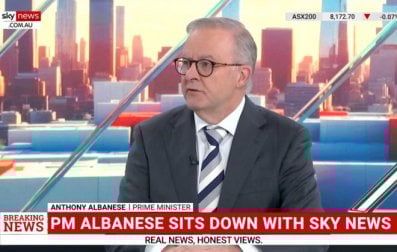
Prime Minister Anthony Albanese’s re-election pitch is stark and singular, warning of chaos and financial hardship under a government led by Peter Dutton.
Adamant that Labor cannot allow the election to become a referendum on cost-of-living pressures over the past three years, senior Labor strategists believe their campaign must shift the focus from economic grievances to a stark choice between Albanese and Dutton that frames the contest as a decision about character, vision and trust.
The strategists see current polling as fluid, with most voters yet to seriously consider their final choice. Confident that opinions remain unsettled, Labor has moved quickly during the unofficial campaign period to roll out its paid advertising early. The Coalition is yet to release any.
One advertisement released on Sunday – which has been criticised for misleading viewers by taking Dutton’s words out of context – features a manipulated video in which Dutton declares “Medicare is dead” and suggests a Dutton prime ministership would undermine the healthcare system.
Another advertisement highlights the Coalition’s opposition to Labor’s cost-of-living measures, such as the expansion of fee-free TAFE and the establishment of Medicare urgent care clinics. This ad asserts that “you’ll be worse off under Dutton”.
The ads go beyond focusing on policy, however. Labor is also betting that first impressions matter – and that voters’ reservations about Dutton will, at least in part, be shaped by his appearance. Expect their ads to lean into this, featuring stark, close-up portraits that emphasise a severe, unyielding expression.
Despite his team’s efforts to soften Dutton’s image – the blue-framed glasses, the light and bright TikTok videos – Labor strategists see his austere, imposing look as a liability, and one that reinforces their message that a Dutton prime ministership would be harsh, divisive and a risk to ordinary Australians.
https://www.youtube.com/watch?v=QxPUP_-2h40&ab_channel=TheSaturdayPaper
Minister for Employment and Workplace Relations Murray Watt believes hammering Dutton’s negatives could be an effective strategy, based on his doorknocking last weekend in Griffith – once a Labor stronghold under Kevin Rudd but now a Greens-held seat with Max Chandler-Mather on a 10.5 per cent margin.
“What really stood out for me was several people who saw Peter Dutton as a drawback, women in particular. I spoke to two women at different doors, both roughly in their 40s, who said, unprompted, that they ‘couldn’t have Peter Dutton’ as prime minister,” Watt tells The Saturday Paper. “It sounded to me like they were very strong on their position, and it was definitely Dutton personally that they had an issue with.”
While Labor’s campaign will focus relentlessly on Dutton, there are some lines its campaign won’t cross, such as attempting to highlight the Liberal leader’s record as an astute property investor. Another no-go area is anything that touches on Dutton’s nine years as an officer in the Queensland Police Service.
And the strategy will be broader in scope than just driving up Dutton’s perceived negatives. “While it has been very difficult times for people over the last few years, the government has been able to provide people with real and meaningful cost-of-living relief, as well as laying the foundations for some of the bigger changes that we want to make if we’re lucky enough to get a second term in areas like healthcare,” says one Labor strategist.
The strategist turns to the case for another term, to “build on the foundations that we’ve laid”, and for Albanese as “likeable and down-to-earth … a person who is in touch and on your side”.
“That’s a contrast that we think is a useful one that can do some work for us,” the strategist adds.
According to Google’s Ads Transparency Center, federal Labor has spent more than $440,000 on advertising on platforms such as YouTube, Google search and others, compared with only $24,000 over the same period spent by the Liberal Party’s federal division. According to Meta’s advertising library, federal Labor has spent more than $44,000 on its platforms, which include Facebook and Instagram, over the past 30 days, with the federal Liberal division yet to roll out a significant campaign spend on Meta.
Labor’s advertising campaign is led nationally by Dee Madigan’s Campaign Edge, with the Moss Group to help with targeted messaging in Western Australia and The Shannon Company to help counter the Greens.
Advertising executive Damian Damjanovski, a former senior adviser to Scott Morrison as prime minister and now a director at Sydney-based creative agency General Strategic, describes the ads Labor has released so far as the first tranche in what will no doubt end up being quite a personality-focused election campaign from both sides.
“The clear reason for this is that Labor haven’t done enough in the public’s view to curtail cost-of-living pressures, and the Coalition haven’t put up enough policy to demonstrate that they’d do any different. So both sides and their associated third parties will increasingly go for personal attacks instead,” Damjanovski tells The Saturday Paper.
“I think these initial campaign materials fall into the standard trap that poor-performing incumbents face when they’re approaching an election as they hit the realisation that nobody can name a single positive thing they’ve done over the past three years,” Damjanovski adds.
“And while the ALP are hoping that an ad showing a literal matrix of ‘all the things they’ve done to ease cost-of-living pressures’ at the start of their latest TVC, the old adage holds true that if you throw 20 oranges at someone, they’re unlikely to catch a single one.”
Outside of their paid television commercials, Damjanovski says another thing he has noticed about Labor’s campaign so far is the decision to go hard early with primarily organic content generated by individual MPs on both new and old social media platforms such as RedNote, TikTok, as well as Facebook and Instagram.
While the content coming from the Labor side has been, in his view, better than what Coalition MPs have done so far, “it’s hard to see a cohesive strategy coming together as yet, given they’ve not been able to stick to one for the past three years”.
“I’d be betting that the clever cookies over at ALP HQ are probably keeping their gunpowder dry until the white car gets to Government House and then they’ll kick off in earnest,” says Damjanovski. “I’d anticipate their strategy is to do anything to make the ‘cost of change’ to a Coalition government seem too hard to swallow for undecided voters – while leaving themselves enough room to wedge the Coalition on individual policy issues as they unfold over the campaign.
“For the most part, both the ALP and Coalition will be running tried-and-true campaign strategies this cycle. Labor will harp on about how healthcare and schools will be at risk under a Dutton government, and the Coalition will peg everything on being better economic managers and stronger on national security and sovereignty than Albo. Meanwhile, the voting public just wants to know why the fuck their flat white suddenly costs $8.”
The Coalition has yet to fully engage in paid advertising, but Dutton has made his direction clear. He launched the party’s unofficial election campaign at a Melbourne rally on January 12, unveiling his key priorities in a document titled “Let’s Get Australia Back on Track”.
It outlines the Coalition’s vision across 12 areas, with the top five focusing on cost of living, building a stronger economy, backing small business, advocacy for a balanced energy mix that includes nuclear power, and fixing the housing crisis. The document will serve as the Coalition’s blueprint for addressing current challenges and guiding Australia’s future under Dutton.
According to Labor strategists, the most interesting thing about the document is how much the slogan “Let’s Get Australia Back on Track” resonates with United States President Donald Trump’s slogan “Make America Great Again” – something they believe will turn off swinging voters in this country.
“The interesting thing about that slogan is that it’s very Trumpy, which I don’t think is what they intended,” says one Labor adviser. “A lot of voters see that and hear that, and hear him saying ‘make Australia great again’ and it really unsettles and unnerves them.”
That unintended consequence, the adviser added, may partly explain why Dutton opened a press conference in Canberra on Tuesday to present a bipartisan position when it comes to US intentions to impose a possible 25 per cent tariff on all steel and aluminium imports.
“I think it’s very important for the United States and for the Trump administration to hear that there is a bipartisan position in relation to the prime minister’s call to remove this tariff from a very close and dear ally of the United States,” Dutton said. “I want there to be a very clear message to the Trump administration that we don’t believe that this tariff should be put in place. If it remains in place, then I believe it will damage the relationship between the United States and Australia.”
Though the press conference gave Dutton an opportunity to demonstrate his statesmanlike potential, to model himself as prime minister, the Labor adviser noted it was “quite a deviation from the more critical stance they’ve been adopting about our relationship with the US”. In their view, it may well have been a reaction to feedback that the “back on track” message “positions Dutton a bit too close to Trump”.
On the ground, however, there are those who harbour doubts about the strategists’ visions. In the metropolitan Melbourne seat of Menzies, once a blue-ribbon Liberal seat and now notionally a Labor seat after last year’s redistribution, local member Keith Wolahan tells The Saturday Paper the conversations he has been having with voters knocking on hundreds of doors in recent months consistently comes back to one key theme.
“What I have learnt is that people in my electorate are hurting in a way that they have not seen in their lifetimes, and that is probably worse than what people were feeling in the early ’90s in Melbourne, living pay cheque to pay cheque,” says Wolahan, who argues that Labor will come to regret any move to focus their campaign on Dutton’s perceived weaknesses.
“I think they will regret it for this reason,” says Wolahan. “It will send a stronger signal that they are not interested in the issues that actually matter to them, and they are more interested in the Canberra contests on character. And I think the only focus on all of us should be addressing the here-and-now concerns that people have for paying the bills and keeping the households afloat and even keeping their home. So, if they do that, I think that’s a mistake.”
This article was first published in the print edition of The Saturday Paper on February 15, 2025 as "Ad nauseam campaign".
For almost a decade, The Saturday Paper has published Australia’s leading writers and thinkers. We have pursued stories that are ignored elsewhere, covering them with sensitivity and depth. We have done this on refugee policy, on government integrity, on robo-debt, on aged care, on climate change, on the pandemic.
All our journalism is fiercely independent. It relies on the support of readers. By subscribing to The Saturday Paper, you are ensuring that we can continue to produce essential, issue-defining coverage, to dig out stories that take time, to doggedly hold to account politicians and the political class.
There are very few titles that have the freedom and the space to produce journalism like this. In a country with a concentration of media ownership unlike anything else in the world, it is vitally important. Your subscription helps make it possible.
Subscriber exclusive
Send this article to a friend for free.
Share this subscriber exclusive article with a friend or family member using share credits.