News
Two years into the decade-long national plan to end gendered violence, key reviews released this week have highlighted significant shortfalls in the strategy. By Karen Barlow.
Frustration over national domestic violence plan
Prime Minister Anthony Albanese, who in April called violence against women and children a national crisis and took it to national cabinet, said during this busy parliamentary week that there was “nothing more important than this”.
Two reports this week question his assertion. One is a sober progress report of the National Plan to End Violence Against Women and Children – now two years into its implementation – led by Domestic Family and Sexual Violence Commissioner Micaela Cronin. The other is a scathing rapid review by a panel of independent experts into the plan's violence prevention efforts.
“In April 2024, the Prime Minister labelled a rise in homicides of women and children a national crisis. This rise follows a recent upward trend, despite the decline over the previous three decades. Yet even this categorisation as a ‘crisis’ belies the problem’s true scale,” the rapid review states.
The panel wants ending violence to become an ongoing priority of national cabinet as it is “an appropriate body to continue to monitor what the review suggests is more than a national crisis, but a national emergency.”
The 21 recommendations from the rapid review, commissioned out of national cabinet and itself a response to rising community anger, includes a “significant funding uplift in certain frontline areas” and an independent review and expansion of “Change the story”, the evidence-based violence prevention framework, beyond primary prevention.
The review noted that over just 12 weeks it became clear that “the path ahead does not just involve tinkering at the edges but instead requires a surge of activity and investment around people, responses and systems”. It says the current framework prioritises gendered drivers of violence over risk factors such as substance abuse and child maltreatment, which “does not align with internationally accepted prevention models”.
Specifically, among its recommendations, the review backs a total ban on gambling advertising, potentially alcohol restrictions and an examination of the density of electronic gaming machines, noting these industries are too often function as the “foundation for, or means of, the escalation of abuse.”
Led by Cronin, the director of the Office for Women Padma Raman, and Secretary of the Department of Social Services Ray Griggs, the panel included a strong critic of current strategies, in specialist journalist Jess Hill. Todd Fernando, the founder of Koorie Pride Victoria, was also on the panel. The review specified that Aboriginal and Torres Strait Islander peoples must be “explicitly prioritised” and governments recognise that domestic family and sexual violence in Australia is rooted in “our historical context and colonial legacy.”
Minister for Women Katy Gallagher thanked the panel in a statement Friday: “We know that preventing violence is complex, and the guidance in this report will help Government build on the National Plan and its existing work and consider how to further prevent violence – to stop it from occurring in the first instance, to prevent it from escalating, and to stop women being killed.”
Frustration surrounding the national plan has long been palpable among those on the resources-strapped domestic violence frontline. “More investment is needed and more participation,” the chief executive of the ACT Domestic Violence Crisis Service, Sue Webeck, tells The Saturday Paper.
“We know what we need to do, but we don’t have the money or resources to do it. And then we are sitting at, essentially, a government update, hearing we need more data, and we need to think about investment and listening to the stories of those with lived experience.
“Nobody is funding us in the way that changes that domestic violence trajectory in the community.”
The financial challenge faced by frontline services is a key focus of the 126-page progress report, which states that short-term funding is “entrenching uncertainty and instability for a workforce already under pressure”, and so is “hampering efforts of the service system”.
In her presentation of the early days report card to the National Press Club in Canberra this week, Cronin reinforced this point. “Despite having very, very significant increases in funding over a period of time, over the last decade, really, our service systems are overwhelmed, stretched beyond capacity. They are struggling to hold on to staff, and they are really at wits’ end about how they going to meet the needs,” she said.
The rapid review also proposed the establishment of a five-year prevention innovation fund, with joint contributions from the Commonwealth and states and territories.
Another frustration expressed by victim-survivors of abuse is with the way in which legal and financial systems can be exploited by violent partners. Toni Shrubshall has experienced this first hand – her home will shortly go to auction to pay a $300,000 multi-year revenge debt incurred by her former de facto partner and shared with her. She says the Family Court, the Australian Taxation Office, senior politicians, local MPs, Legal Aid and the Australian Human Rights Commission did not, or could not, help.
The small business owner, who works out of the home she is about to lose, says financial abuse was not recognised nor addressed by the tax office and the court.
“I put my trust into a system, thinking it was there to protect me, and instead it’s become more punitive than being protective,” Shrubshall tells The Saturday Paper. “I had no idea what was happening to me.”
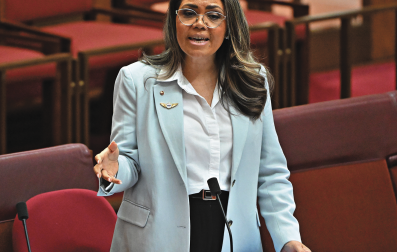
In her press club address, the commissioner also said she was aware the government was reviewing its payment systems, such as the child-support system, to stop them from being used by former partners to financially punish women. Minister for Social Services Amanda Rishworth later confirmed a number of reviews “informed by a stakeholder consultation group” is under way “looking closely at compliance, with a focus on income accuracy, collection and enforcement”.
“We are committed to making sure that awareness of family and domestic violence is embedded in our processes from the beginning,” the minister says.
Rishworth accepts there is a “huge amount of work” to do and insists family and domestic violence is taken very seriously by the government.
“We have $3.4 billion worth of investments over 85 initiatives, and we have continued to work with states and territories on this issue,” she says.
In light of calls from some advocates – including from Sex Discrimination Commissioner Anna Cody in this paper last month – for the government to treat gendered violence the same way it does terrorism, the minister says measures are being considered that would facilitate more integrated national responses.
“When it comes to high-risk offenders, actually sharing information across jurisdictions was something that was reported at national cabinet, and something that I know data and digital ministers are looking at.”
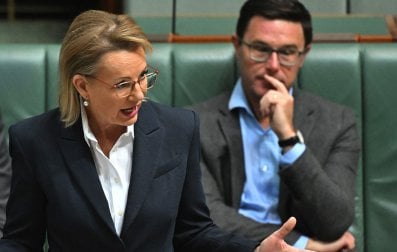
The opposition believes there is a risk of going backwards and the deputy leader has again raised Labor’s unfulfilled election promise to fund 500 frontline domestic violence support workers.
Alongside the threats she noted from violent pornography, social media influencers peddling misogyny and social media companies profiting off algorithms, Sussan Ley has linked the rise in gendered violence to the cost-of-living crisis.
“We risk a regression as the stress of economic strain is generating new cycles of domestic violence, and new forms of abuse. And we know that the economic pain will continue with difficult days to continue,” she told parliament.
The 500-workers promise is now in the hands of the states and territories, according to Rishworth, as she said the jurisdictions had received funding and they were in “various phases of their recruitment”. She said she “looks forward to them delivering on their commitment”. There is now a departmental page devoted to monthly updates on the status of recruitment.
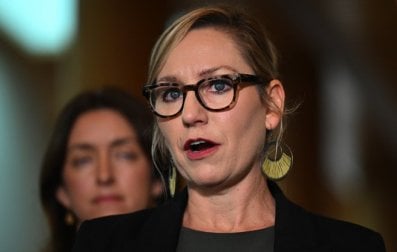
Hearing that there was “nothing more important than this” from the prime minister raised expectations for Greens Senator Larissa Waters, who is looking for more commitments in the Mid-Year Economic and Fiscal Outlook. “You can’t just say that and not put dollars behind those words and it’s long overdue that we saw full funding of frontline services and decent and ample funding for prevention work,” she tells The Saturday Paper.
“There is some positive prevention work being done and our national curriculum with respect to relationships education exists, but schools and teachers themselves don’t have the funding or the training to deliver that material consistently.
“So, it is good on paper, but in practice that delivery is really lumpy. That needs to be fixed as well.”
Another frustration surrounding this week’s reviews is that while the urgency of the task to reduce gendered violence is widely understood, the metrics are not in place to closely track progress. Target one of the national plan clearly states that the number of Australian women killed each year by their partner should go down by at least 25 per cent each year, and these interim reports are relying heavily on anecdotal findings.
Speaking at the press club, Cronin conceded there was little formal data to measure progress as yet, as much of it was collected only every four to five years.
“This report is on the anniversary of the two action plans being launched last August, so until we see the detailed reporting from those, what we are reporting on is what we have been hearing. I would say that we are on track in many regards.”
Leading researcher Kate Fitz-Gibbon says missing data is a barrier to crucial insight into violent behaviour. “There is a critical need across Australia to better understand perpetration and perpetrator behaviours. We simply cannot eliminate what we do not fully understand. Collecting more comprehensive, perpetration-focused data is a key first step.”
In addition to the focus on frontline services, the Monash University professor says the scale of the gendered violence problem is so huge it can’t be tackled successfully without a significant elevation of resources to early intervention and response services.
“We are missing opportunities to intervene earlier and interrupt perpetrator trajectories of harm,” Fitz-Gibbon tells The Saturday Paper.
The commissioner also wants the focus to be on men and boys. What is “desperately” needed, she told the press club, is more data about men and violence as well as ways to help men who are concerned about their own behaviour.
“We don’t have enough services available when men call and say ‘I’m a bit worried about my behaviour’, and we know, I talked to many service providers who say they are getting those calls and that there is nothing that they can offer at the moment, very little that they can offer,” she said.
In the absence of clear tracking of targets, Cronin wants more data to understand how the services are coping with the national crisis in domestic violence.
“We need better data, we need to be thinking about absolutely funding what we know works and we need to be evaluating every program,” she said. “We need to make sure that it’s built-in to program contracts that everything is evaluated, and those evaluations are shared publicly.”
This data exists, says Sue Webeck.
“I guarantee you, if the government started saying ‘we need this data off you’, that is not a five-year project. That is actually, ‘these are the pieces of data we have got, and this is how we can give it to you,’ ” she says.
“We need to stop talking about it and we need to fund and resource specialist organisations and community-led initiatives to actually achieve against the outcomes of creating a safer environment for women and children, supporting men to engage in positive behaviours and to hold perpetrators of violence accountable.
Cronin says prevention and protection models must have “eyes on men” if women and children are to be kept safe. It is “talking with and about men more”.
“We need to be engaging with men in different ways than we are now,” she told the press club. “Most of our service system has been designed to move women around. It’s designed around eyes on women. Women have much more help-seeking behaviour. Women are more visible to the system.”
What is clear is that 2024 is already a horrific year. A woman is currently killed every four days. Forty-three women died last financial year at the hands of intimate partners, while family domestic and sexual violence has killed and harmed many more. At least 10 children have died violently this year, according to Australian Femicide Watch. First Nations women are six times more likely to die than non-Indigenous women.
In a year of community frustration and anger at the mounting deaths, leaders are being urged to step up.
“I want this to be an election issue,” Cronin said.
“The national plan is a good foundation, but we need to be thinking about how we build on that going forward.”
This article was first published in the print edition of The Saturday Paper on August 24, 2024 as "Inaction plan".
For almost a decade, The Saturday Paper has published Australia’s leading writers and thinkers. We have pursued stories that are ignored elsewhere, covering them with sensitivity and depth. We have done this on refugee policy, on government integrity, on robo-debt, on aged care, on climate change, on the pandemic.
All our journalism is fiercely independent. It relies on the support of readers. By subscribing to The Saturday Paper, you are ensuring that we can continue to produce essential, issue-defining coverage, to dig out stories that take time, to doggedly hold to account politicians and the political class.
There are very few titles that have the freedom and the space to produce journalism like this. In a country with a concentration of media ownership unlike anything else in the world, it is vitally important. Your subscription helps make it possible.
Subscriber exclusive
Send this article to a friend for free.
Share this subscriber exclusive article with a friend or family member using share credits.