News
As an international coalition steps up support of Ukraine in its war with Russia, Opposition Leader Sussan Ley has backed the prime minister’s offer of Australian forces to join peacekeeping efforts. By Karen Barlow.
Australia’s united front on Ukraine
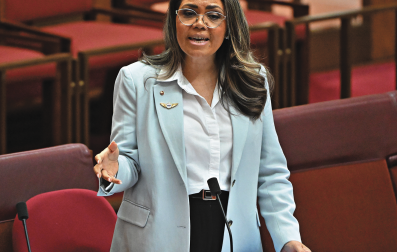
A degree of bipartisanship has emerged in Australian foreign policy, as Anthony Albanese and Sussan Ley agree they are willing to send peacekeepers as part of a “reassurance force” to Ukraine.
As United States President Donald Trump rules out sending American troops to the strife-torn nation as part of any deal to end the war that began with Russia’s February 2022 invasion, Ukraine is seeking back-up among Western democracies. Along with European Union countries, Australia and New Zealand are pledging support in a “coalition of the willing” that now has more than 30 members.
Albanese has stated that Australia is open to providing peacekeepers – but not to sending troops to fight.
“What we want to see is peace and an end to conflict, whether it be in Ukraine or whether it be in the Middle East,” Albanese told reporters in Adelaide before denouncing Russian President Vladimir Putin’s “untrustworthy” character and his “imperialist designs”.
“It is relevant to Australia in our own region. If a big, powerful country can impose its will through military might on a smaller country, that has implications for the world. What we need is for international norms to be respected.”
The opposition leader’s stance is a marked shift from that of her predecessor, Peter Dutton, who supported Ukraine against Russia’s “evil” full-scale invasion but shut down in March any notion of sending Australian troops. He described the proposal as a distracting pre-election “thought bubble” from Labor.
“It’s clear that this is an area where we needed to evolve our position from what it was previously, and especially because events on the ground have evolved and the prospects for a peace settlement have actually increased. So, you can point to that evolution of our position,” Ley tells The Saturday Paper.
“We absolutely, unequivocally support Ukraine in its fight against Russia’s illegal and immoral invasion, and we have said we’ll work constructively with the government in our national interest when it comes to international relationships. So those two propositions are there.
“With respect to a peacekeeping force in Ukraine, we would assess any concrete proposals that they would bring forward … Nothing is actually in front of us at the moment, but we would assess anything that the government would bring forward.”
It is a bipartisan note missing from discussions over the war in Gaza and the increasingly strident criticisms from Israeli prime minister Benjamin Netanyahu since Albanese committed Australia to recognising Palestinian statehood at next month’s United Nations meeting.
“It’s always a good thing to work constructively with the government on matters of international relationships, which is why I’ve always said we would be well disposed to doing exactly that. So, you know, that option is there,” Ley says of Ukraine support in Australia.
Shadow minister for Home Affairs Andrew Hastie started the road back to major party alignment on Ukraine, questioning his former leader’s firm position against peacekeepers on the ABC’s Insiders in June.
“The prime minister ruled in Australian troops without an offer, and Peter Dutton ruled out Australian troops. My view was let’s wait for an offer and consider the merits of a request at the time,” Hastie said, noting that any deployment would be “very specialised”.
Coalition frontbencher James Paterson says a peacekeeping mission for Australia would be a “symbolic contribution”.
“Very clearly, the heavy lifting would be done by NATO in this instance, but we are a partner of NATO and if we’re asked to make a contribution, we should consider it,” he told the ABC on Tuesday.
The tempo of the prime minister’s late- night virtual meetings with the “coalition of the willing” has picked up, with two this week to discuss further military support for Ukraine, additional sanctions on Russia and advancing Ukraine’s membership of the EU.
They follow Putin and Trump’s meeting in Alaska last week and the US president’s suggestions Ukraine cede territory, abandon its long-held aims to join NATO, and for President Volodymyr Zelensky to meet with Vladimir Putin.
The subsequent convoy of European leaders to join the Ukrainian president at the White House was the most obvious of the intensifying signals of solidarity and commitment from across the Atlantic.
Leaders from the coalition of the willing are preparing for the “deployment of a reassurance force if hostilities ended”, the British prime minister’s office announced this week. The proposed peacekeeping forces are just one element of a highly coordinated grouping of more than 30 nations, led by the UK and France.
“The coalition of the willing was established to better coordinate assistance to Ukraine, which includes military, economic and humanitarian aid,” Ukrainian Ambassador to Australia Vasyl Myroshnychenko tells The Saturday Paper.
He says it’s “too early” to make any official request for an Australian presence, however, until a ceasefire deal is reached.
“We need to get some sort of truce arrangement,” Myroshnychenko says. “We need everybody to agree on a potential mandate of those troops. Will it be called peacekeeping? Will it be called stabilisation troops? Whatever they are going to be called.
“The request to Australia will come in due time, if ever, and then you decide how many people you’re going to send.”
Albanese makes it clear that Australia’s involvement – which so far comprises upwards of $1.3 billion of military support and more than 1400 targeted sanctions against Russian entities and individuals – is about more than Ukraine.
Australia has a proud history of standing up for principles and the rule of law, says former Australian ambassador to Russia Peter Tesch.
“It’s more than just a gesture, it is very squarely aligned with our beliefs, with our lived experience and with our interests,” he tells The Saturday Paper.
The federal opposition leader says unity with like-minded partners is important.
“It would be about our shared values and our strong stance in the face of something that has been and remains completely unacceptable, this one-sided invasion from Russia into Ukraine,” Sussan Ley says.
“We pushed the government already. We pushed them on the tanks, we pushed them on shipments of coal,” she says. “We stand ready, of course, to have those conversations with the Ukrainian ambassador and to demonstrate to him more broadly what I’m sure he already knows, that we unequivocally support Ukraine.”
A decade ago, the Coalition also faced the possibility of sending an Australian military unit to Ukraine, following the shooting down of Malaysia Airlines flight MH17 in 2014 by Russian separatists. The disaster, in which 298 people were killed, came in the wake of Russia’s invasion and annexation of the Crimean Peninsula. Then prime minister Tony Abbott wanted to send troops to help recover the bodies of 38 Australians from the site of the wreckage. Last month, the European Court of Human Rights found Russia was responsible for the deaths of everyone onboard.
Today, Abbott backs a possible peacekeeping force on the ground in Ukraine with an Australian contingent. “I would fully support a commitment of Australian peacekeepers to a stabilisation force, especially if it were British led,” the former Liberal leader tells The Saturday Paper.
“Without a significant Western military presence on the ground in Ukraine, any ceasefire would just be a pause for Putin to regroup and resume his aggression. Given that a significant foreign force is needed to secure peace with a degree of justice to the long-suffering people of Ukraine, I think an Australian contribution would be in keeping with our long tradition of helping the weak and upholding the right.”
The realigned position on peacekeeping is welcomed by the Ukrainian ambassador, who warns about the possibility of Trump giving up on trying to secure a peace deal.
“That will be the best scenario for Putin, and that’s something we need to all avoid, because if that happens, I think you all are in trouble. We all are in trouble, including Australia,” Myroshnychenko says. “So for us, it’s a matter of survival, but it also sends a very wrong signal to your adversaries here in the region.”
The possibility of Australian peacekeepers would not change Russia’s view of Australia, according to Tesch. He says Australia is already an adversary.
“The thing that has taken a long time to dawn upon people’s consciousness in this country is that the Kremlin, for at least a decade and longer, has seen us as an adversarially minded country,” the former ambassador says.
“The very fact that we have been acting so consistently in concert with the Netherlands in particular over MH17 is something that registers in the Kremlin’s view of us … [That] we’ve imposed sanctions since Russia’s illegal annexation and occupation of Crimea in 2014 has identified us in the Kremlin’s eyes as, if not a full enemy, then at least an opponent.”
In the meantime, Russian attacks have picked up pace and determination since the summit in Anchorage, Alaska.
As for how the next steps might proceed, says Tesch, who is now a fellow at the Australian Strategic Policy Institute, “there is a long way to go to determine the elements of a comprehensive and acceptable peace settlement. I don’t know how you can talk about swapping territory when it’s all Ukrainian territory.
“Moreover, Russia would not accept third-party security guarantees for Ukraine that would be credible and effective in deterring future Russian aggression,” Tesch says.
“I don’t think that we should be encouraging people to believe that we’re likely to be, at the fore, deploying a company of anything of particular size to be patrolling the streets or a line of contact, because I think there are other militaries that are more proximate, that are better equipped to do that.”
If there were to be a commitment of Australian personnel, Tesch suggests its strengths would be in the area of training, logistics and transportation, in particular air-to-air refuelling and aerial transportation capabilities.
While President Trump has ruled out American boots on the ground in Ukraine as peacekeepers, he has flagged the possibility of US air support, but that too is still to be worked out. “There’s going to be a lot of help,” Trump told reporters this week. “We are going to help them out also. We’ll be involved.”
What Ukraine can now expect is NATO-like help from NATO – something closer than Putin would like to the threat of membership that he cited as one of the “root causes” of his invasion of Ukraine.
All that is needed is the not small detail of a peace deal.
This article was first published in the print edition of The Saturday Paper on August 23, 2025 as "Australia’s united front on Ukraine".
For almost a decade, The Saturday Paper has published Australia’s leading writers and thinkers. We have pursued stories that are ignored elsewhere, covering them with sensitivity and depth. We have done this on refugee policy, on government integrity, on robo-debt, on aged care, on climate change, on the pandemic.
All our journalism is fiercely independent. It relies on the support of readers. By subscribing to The Saturday Paper, you are ensuring that we can continue to produce essential, issue-defining coverage, to dig out stories that take time, to doggedly hold to account politicians and the political class.
There are very few titles that have the freedom and the space to produce journalism like this. In a country with a concentration of media ownership unlike anything else in the world, it is vitally important. Your subscription helps make it possible.
Subscriber exclusive
Send this article to a friend for free.
Share this subscriber exclusive article with a friend or family member using share credits.