News
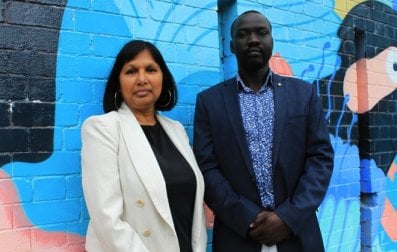
Sydney’s Asylum Seekers Centre has been helping refugees for 32 years. Now its running will be entrusted to a man who truly understands what it means to walk through its doors. By Sarah Price.
Elijah Buol to lead Asylum Seekers Centre
Frances Rush began her work at the Asylum Seekers Centre in Sydney in 1993, the year it opened. Located then in Surry Hills, in a small cottage provided by the Good Shepherd Sisters, the centre had no funding, only one paid staff member and a group of volunteers. Basic employment supports were offered. There were hot meals, links to health services and a social club on weekends. Every part of the cottage was utilised, including the garden.
More than three decades later, the Asylum Seekers Centre, now in Newtown, is hard to miss: the two-storey semi is on a corner and decorated from pavement to roof in murals of yellows, blues and pinks. It now employs more than 40 staff and has 500 active volunteers, with another 3500 on a volunteer waitlist. Every year more than 4600 refugees and people seeking asylum walk through the front door in need of support.
The success of the centre is all about the people, Rush says. “It is where the best of civil society plays out. Our health clinic, the doctors who give their time for free, our physios, the corporates, multi-faith communities: we get enormous support from Jewish, Muslim and Christian communities. The creative arts component: organisations like the NSW Art Gallery deliberately say, ‘You are welcome’, and actively include the people we support through invitations, music, theatre.
“People feel safe here. They know they will be celebrated here. People seeking asylum own this place, in a sense. We have worked hard to elevate the voices of people with lived experience. To see that in place. Keeping places like this alive, when often the political discourse is negative, makes the world of difference. Getting people the right help at the right time means they can get on with their lives and become independent, which is what everyone wants. It is vital.”
This week, after her 32-year association with the Asylum Seekers Centre, including 10 years on the board and the past decade as chief executive officer, Rush is stepping down, to be replaced by Elijah Buol.
When he walked through the centre’s front door, Buol first noticed the mural that said “Welcome” in several languages. The mural, painted by local artist Kelly Wallwork, with help from staff and volunteers, inspires the work at the centre, Buol says. “I feel the sense of belonging, the sense of safety and the sense of support for everyone who walks through our door.”
Buol arrived in Australia in 2002 as an unaccompanied minor. He was 16. He was born in South Sudan during the second Sudanese civil war and his mother died when he was six. Alone and unprotected as a child, he spent eight years in a refugee camp in Uganda. Access to healthcare, food and education was limited. He lived “ration to ration”. Life was tough, he says, but there was always hope.
In Australia, Buol lived in a group home with other young people and was given help from neighbours, the church and community members. His mentor and teacher, Dr Annette Rutledge, arrived at school at 7am every morning to teach him English.
Buol has worked as Queensland state manager of migration support programs for the Australian Red Cross, and as chief executive officer of Act for Peace. He has served as general secretary of the Refugee Communities Association of Australia and as a member of the Australian government’s Settlement Advisory Council. For 12 years he facilitated a campaign to remove children from adult prisons in Queensland. His advocacy was successful, with the last juvenile being released from an adult prison in Queensland in 2018. A year later Buol was named Queensland Local Hero of the Year and awarded the Medal of the Order of Australia for contributions to multicultural communities and youth advocacy, becoming the youngest person in Queensland’s history to receive the accolade.
“What I’m so passionate about is the idea that hope is born out of compassion – that kindness of ordinary people,” Buol says. “My own experience is exemplified by the work we do. For me, like many asylum seekers that we support today, I have gone through hardship over the years and I have witnessed through my life as a young fellow the compassion of people. The system in Australia is broken. For me to walk alongside asylum seekers within this broken system inspires me every day.”
In the past year the Asylum Seekers Centre has provided hundreds of GP consultations and external health referrals, daily hot meals, employment services, assistance with affordable childcare and preschool placement, support with school enrolment, university and TAFE scholarships, LGBTQIA+ support programs, Opal card top-ups, repurposed devices and more.
Rush says there is an increase in people presenting to the centre in crisis, or slipping further into crisis. In the past financial year about half the people seeking support at the centre were homeless or at risk of homelessness. Staff estimate the majority of people referred to the health clinic now present with some form of mental illness due to trauma and the pressure of being trapped in limbo in the current system.
“The impact of the toll on people’s mental health is terrible,” Rush says. “When the centre was first established, when Keating was prime minister, people seeking asylum would wait between 12 and 18 months before they had an outcome for their claim for protection. Now, 32 years later, we have people who wait five, seven, 10 and more years … We have seen increasingly over that time – through both the Howard years and the Rudd–Gillard government, and now the current government – less compassion and humanity. They have moved to a punitive, toxic approach to people seeking asylum … weaponising the issues of migration and downplaying the enormous contribution that people seeking asylum and refugees make to our community.”
Rush continues: “There is more exclusion. Albanese says no one will be left behind, and we want a more compassionate and fair approach. The platform that Labor came into government on was that they would reinforce a safety net, and yet it hasn’t happened.”
Buol has recently relocated from Ipswich to Sydney, with his wife and four children to follow at the end of the school year. He has left his extended family in Queensland.
“I am driven by hope,” Buol says. “The stamp of the past does not define the next destination for us. We are in this world for a reason. What legacy are we going to leave? Do the best you can with your ability. Take opportunities. That is the beauty of Australia: we have great opportunities. How we support people to tap into those opportunities is what matters.
“Life will always throw challenges. I have found myself in situations becoming hopeless, but when I chose to become hopeful it was because I relied on the support of others. There is always tomorrow. Tomorrow cannot come without solidarity, without those who will lend you a voice and support. Society can work together to embrace humanity for all.”
Like many people seeking asylum in Australia, Buol says he arrived here with nothing but hope and aspiration. He was reliant on the generosity of the community. “I have gone through that. For many people who are displaced the answer is looking for safety here, looking for that certainty. My message to the government, to people, to the community, is that each of us has the power to create hope and a safe place. Through compassion we can nurture resilience in ourselves and in our communities. Humanity has no boundaries.”
Buol says he is looking forward to working alongside people who are seeking asylum. He wants to walk in the shoes of people who face challenges today. He wants to create long-term impact. In his own life he always asked for support, and the support he received is what kept him going.
“I was supported by so many,” he says. “This is born out of those people who are willing to help those who need the support the most. That resonates with the work we do at the centre. We have many Elijahs here – we just need to hold their hand.”
This article was first published in the print edition of The Saturday Paper on August 16, 2025 as "Come so far".
For almost a decade, The Saturday Paper has published Australia’s leading writers and thinkers. We have pursued stories that are ignored elsewhere, covering them with sensitivity and depth. We have done this on refugee policy, on government integrity, on robo-debt, on aged care, on climate change, on the pandemic.
All our journalism is fiercely independent. It relies on the support of readers. By subscribing to The Saturday Paper, you are ensuring that we can continue to produce essential, issue-defining coverage, to dig out stories that take time, to doggedly hold to account politicians and the political class.
There are very few titles that have the freedom and the space to produce journalism like this. In a country with a concentration of media ownership unlike anything else in the world, it is vitally important. Your subscription helps make it possible.
Subscriber exclusive
Send this article to a friend for free.
Share this subscriber exclusive article with a friend or family member using share credits.