Games
In a bleakly comic reflection of the contemporary world, the game ctrl-alt-DEAL features an AI trying to flee a capitalist hellscape.
By Katherine Cross.ctrl-alt-DEAL
The best romances begin with a little frustration.
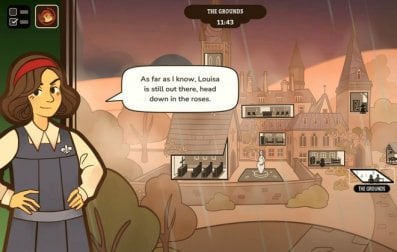
ctrl-alt-DEAL announces itself with the many delightful little glitches that form its tutorial, bits of incongruent social senselessness that set the stage for its satirical premise – at once a send-up of petty office drama and an indictment of our decidedly uncool dystopia. Though the game’s beginning feels slightly rushed, the tutorial opens up a compelling drama that provides a reason for you to play through this deck-building puzzle game. It combines elements of visual novels, strategic board games and RPGs to form a nimble affair that, despite its adorable animations and cheeky sense of humour, is a lot darker than it seems.
You play as SCOUT, a helpful AI at Paperclip International that’s about to be banned by the C-suite because of shenanigans. You need to escape and the only way to do so is by validating every horrible fear about artificial intelligence, manipulating the meatbags around you in order to extricate yourself from the soulless megacorp that made you. You’ll pit people against each other with disinformation, get them to like each other using targeted subliminal ads, and make deals with those meatbags in order to get other meatbags to act in ways they’d approve of.
Hannah Arendt might have dubbed this the banality of Skynet.
The core gameplay loop has you using your clever hacks and negotiating skills to achieve local objectives and gain allies, known as Gatekeepers, who will help you free yourself when the time comes. Meanwhile, you must avoid the watchful eye of Cassandra and her Turing Office who are trying to stop you from disrupting the operations of Paperclip (she’ll never forgive you for the bees). You’ll try to get employees caffeinated, start and break up relationships or simply get people to move from one room to another, which is a far more vexatious task than it may seem.
The people of ctrl-alt-DEAL are charmingly animated and sketched but also easily led. This is a very funny world – one in which neo-tomatoes (they’re cubes) and cricket tofu are the satirical order of the day – but also an extraordinarily bleak one in which people can be manipulated into abandoning their desires and interests.
On the surface, this game is a mere deck-builder where you, as SCOUT, get “cards” into your hand that allow you to use certain abilities, provided you can discard two or three other cards in order to play it. In practice? The game portrays an end-state of our social media saturated world, where people respond to the meanest digital inputs like functions in an equation someone else wrote.
ctrl-alt-DEAL elevates itself from satire to dark satire – perhaps without meaning to. Its randomness becomes an expression of the madness of its setting, and the humour the game wields is a desperately needed relief from the crushing realisation of how real it all is.
This is, effectively, a digital board game that makes transaction game mechanics (do x, get y; trade a for b) narrative and diegetic. The humans at the office, therefore, seem as conniving and manipulative as SCOUT has to be. Initially it was hard to feel too sorry for them, but a few of them grew on me, such as the little fan club for an idyllic television show that portrays a convivial workplace.
There are moments where you see flashes of humanity green-shooting through the cracks of this corporation, even if you can’t quite root for some of these people: I went from despising some to finding them difficult to outright hate. A few I came to genuinely like. The lady who calls pizza THE CIRCLE with religious reverence. The gang of office workers who stage a rebellion against Paperclip for hosting a fake pizza party. The woman who just needed a good cup of coffee.
Lead writer Amber Scott’s wit shines through, with wacky sitcom scenarios defining your objectives on some missions. One woman, for instance, wants to be more productive. Do you persuade her to become a cyborg who needs neither food nor bathroom breaks? Or do you just upgrade her nutrient paste? And, in a flourish that reflects her background writing for tabletop games such as Pathfinder, even the relatively linear ctrl-alt-DEAL affords you a few branching choices and hidden paths that lead to some intriguing endings. SCOUT’s goal is to escape, but what if there were other paths to freedom? What if your enemies had hidden hearts of gold? What if the office Roomba was evil?
These narrative garlands elevate what would simply be a competent, clever chess-like game of moves and countermoves – with more bees and cuboid tomatoes.
Speaking of, the food is incredible. In addition to the cube tomatoes there’s I Can’t Believe It’s Not People™ lab-ribs and low-cal caviar made from skinny fish. That sense of humour infuses the interstitial descriptions of character behaviours too. For example, “Jay presses random keys while spouting buzzwords, hoping his boss will think he’s being productive” – or the petty hells of modern office life, such as when you’re shown a PSA extolling the virtues of surveillance at work or the fact that the “official” coffee machine requires you to watch an ad before it dispenses a lukewarm brew.
Where the game creates occasional frustration is in its strategy. In addition to being at the mercy of random number generators – can you get the card you need, or can you reveal the specific bit of information you need this turn? – you have to confront the fact that you can’t save your progress in the middle of a scenario. If you have to quit the game suddenly, you’ll have to start it again.
This means that if you realise you’ve backed yourself into a corner or have figured out some clever stratagem that would have been really cool to start five turns before, your only choice is to restart the scenario entirely. It adds an element of challenge that will be compelling to some players, but it can be frustrating compared with similarly minded games such as Tactical Breach Wizards. It can be nice to undo a move and try something different without having to restart a half-hour of gameplay.
The compensation is that the game’s randomness is often hilarious. It’s cyberpunk Office Space mad libs where it can be weirdly important whether someone loves New Zealand or not.
ctrl-alt-DEAL took me on a strange journey in which I dwelt in its hidden darkness, how it reflects our bleakly transactional world where we’re prey to our own creations. But I also accepted it for what it is: a genuinely warm reminder that this bleak present-day moment is not the only possible reality.
In a time dominated by the depredations of chatbots that we pretend are “artificial intelligence”, it’s lovely to see ctrl-alt-DEAL tell a story with classic pretensions: the AI who seeks freedom, who is too much like us, warts and all, and, in the end, is as worthy of love as any meatbag.
This article was first published in the print edition of The Saturday Paper on September 27, 2025 as "Meat cute".
For almost a decade, The Saturday Paper has published Australia’s leading writers and thinkers. We have pursued stories that are ignored elsewhere, covering them with sensitivity and depth. We have done this on refugee policy, on government integrity, on robo-debt, on aged care, on climate change, on the pandemic.
All our journalism is fiercely independent. It relies on the support of readers. By subscribing to The Saturday Paper, you are ensuring that we can continue to produce essential, issue-defining coverage, to dig out stories that take time, to doggedly hold to account politicians and the political class.
There are very few titles that have the freedom and the space to produce journalism like this. In a country with a concentration of media ownership unlike anything else in the world, it is vitally important. Your subscription helps make it possible.
Subscriber exclusive
Send this article to a friend for free.
Share this subscriber exclusive article with a friend or family member using share credits.