recipe
Caramelised onion and gruyere croquettes
There’s no need to be coquettish about fried food. It has a deep allure, but let’s face it: fried food has taken a bad rap over the years. Trans fats, saturated fats, dirty deep-frying oil, questionable ingredients hidden under soggy, bad-tasting batter.
Perfectly executed fried food is a joy to behold, however. So many things need to come into play. Quality fresh deep-frying oil. Good ingredients. An understanding of the temperature of the oil – hot enough to seal the food but not so hot as to overcolour it.
I can remember some dastardly attempts at fried food as a child. Overcrowding our little round GE deep fryer with too much food, not understanding what the effect would be of the resulting drop in temperature. Using the same oil I’d cooked flathead tails in to cook doughnuts. Really, there are some memories better not remembered at all.
Bad memories aside, let’s talk about croquettes. Brought into the modern vernacular by the ever-present Escoffier in about 1898, the name is from the French croquer, “to crunch”. Dare I say it, they were a vehicle for using up leftovers. The croquette then spread across the world. Each cuisine seems to have some version of it. The Spanish and the Italians have become practitioners supreme of the humble croquette, often featuring it on tapas and antipasto platters.
Here we have one of my very favourite pairings: caramelised onion and gruyere, bound together with mashed potato, lovingly rolled into the classic cylinder shape, gently egged and breadcrumbed, and then fried until they are just right.
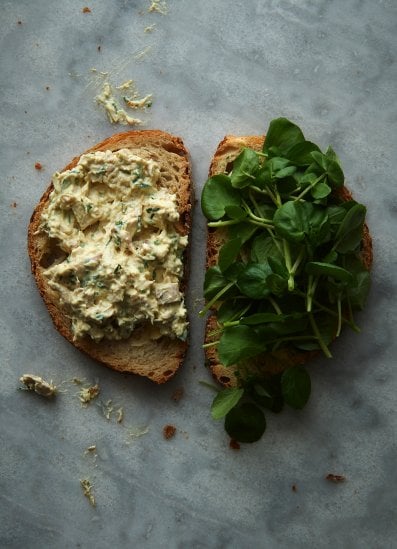
I love fried food like this with a crisp green salad tossed in a sharp vinaigrette to nibble on. However, if you prefer, you could make a little tomato and chilli sauce for dipping or even serve them alongside a rare roasted eye fillet as the potato component.
Time: 40 minutes preparation + 10-15 minutes cooking
Serves 6
- 2 large onions
- 100g unsalted butter
- 500g floury potatoes (sebago)
- 1 egg yolk
- ½ cup gruyere, cut into small cubes
- 75g plain flour
- salt and pepper
Crumbing
- ½ cup plain flour
- ¼ cup milk
- 1 egg
- 1½ cups breadcrumbs
- vegetable oil for frying
Accompaniment
- 100g watercress
- vinaigrette
- Slice the onions finely. Melt the butter in a heavy-bottomed frypan and cook the onions over low to medium heat for 20 minutes or so until completely caramelised. Set aside.
- While the onions are cooking, scrub the potatoes and either boil or steam them until completely cooked. Allow to cool a little, then remove the skin with a small paring knife and mash with a hand masher or mouli.
- Mix together the onions and mashed potato with egg yolk, gruyere and flour. Season to taste. Divide into 12 and shape into cylinders.
- Have three separate bowls, one with flour, one with milk and egg whisked together, one with breadcrumbs. Gently coat each cylinder in flour, dip into egg mix and then into crumbs. Place gently on a tray.
- Heat the oil in a deep pan to about 190ºC. Fry in three batches for three to four minutes or until golden. Remove from the oil and then place on absorbent paper. Keep warm in a low oven while cooking the remainder.
- Serve with a crisp, sharp watercress salad, or a dipping sauce, or as the potato component of a suitable main course.
This recipe is from The Saturday Paper’s archive.
This article was first published in the print edition of The Saturday Paper on September 13, 2025 as "A winning fry".
For almost a decade, The Saturday Paper has published Australia’s leading writers and thinkers. We have pursued stories that are ignored elsewhere, covering them with sensitivity and depth. We have done this on refugee policy, on government integrity, on robo-debt, on aged care, on climate change, on the pandemic.
All our journalism is fiercely independent. It relies on the support of readers. By subscribing to The Saturday Paper, you are ensuring that we can continue to produce essential, issue-defining coverage, to dig out stories that take time, to doggedly hold to account politicians and the political class.
There are very few titles that have the freedom and the space to produce journalism like this. In a country with a concentration of media ownership unlike anything else in the world, it is vitally important. Your subscription helps make it possible.
Subscriber exclusive
Send this article to a friend for free.
Share this subscriber exclusive article with a friend or family member using share credits.